How to Grow a Digital Marketing Agency [+ Expert Tips]
![How to Grow a Digital Marketing Agency [+ Expert Tips]](/images/blog/How-to-Grow-a-Digital-Marketing-Agency-Expert-Tips.webp)
If you’ve been wondering how to grow your digital marketing agency but keep running into vague advice and overly complicated strategies, this article is for you.
When you started your agency, you probably expected growth to follow a clear path: do great work, get referrals, scale your team, and watch revenue grow. But, in reality, things got messy. Maybe your client pipeline has dried up. Maybe you outgrew your systems. Maybe you hired too fast — or not fast enough.
And while there’s no shortage of advice on how to scale a marketing agency, most of it feels either too generic or entirely out of touch with your day-to-day. No wonder you’re searching for practical, proven advice that actually moves the needle. The good thing is we’ve got quite a list for you.
In this article, we’re sharing 12 real-world strategies for growing your digital marketing agency, backed by insights from successful agency leaders like Matt Ross. Matt joined us on the Agency Growth Series podcast a while back to share how he helped Hozio grow from zero to seven figures.
You can check out Matt’s full episode or keep reading for the strategies that have helped Hozio and many other agencies scale and sustain growth.
Tl; Dr: How to Scale Your Digital Marketing Agency
Here’s a quick summary of the growth tips we’ll discuss in this article:
- Choose a niche (but not too early)
- Create a reliable talent pipeline
- Hire M-Shaped employees
- Document your processes and workflows
- Collect social proof and client testimonials
- Invest in scalable SEO tools
- Lower the stakes and make it easy for clients to say yes
- Build repeatable client acquisition systems
- Know your agency’s profit margins
- Focus on client retention
- Productize your marketing and SEO services
- Train your team for scale
1. Niche Down (But Not Too Early)
One of the most common advice for growing a digital marketing agency is to choose a niche. And for good reason — a niche helps you focus your services, target the right clients, and stand out in a crowded market.
But if you niche down too early, it can actually hold your agency back. You might pick a niche that’s too narrow, limit your client pool, or attract businesses you’re not fully equipped to help. In the early stages of your agency, that kind of rigidity can slow down your growth.
Instead, Matt Ross, Senior Vice President and Director of Operations at Hozio, advises agencies to start with a general direction — preferably offering SEO services to their immediate target market. In his words, “Every agency has a starting point, and it doesn’t define you for the life of the business.”
Offer a focused service or work with a specific type of client, but stay open to evolving based on demand, results, and where your strengths shine. For example, Hozio started as a local SEO agency helping small businesses in its area. Over time, the agency expanded its service offerings and started attracting clients across the country. It didn’t stay locked into its original niche. Instead, it let the market guide its growth.
The bottom line is that picking a niche is smart, but don’t be afraid to adjust it as your agency matures.
2. Create a Reliable Talent Pipeline
A reliable talent pipeline ensures you can scale smoothly, deliver high-quality work consistently, and avoid burnout for you and your team. If you’re constantly scrambling to find writers, designers, SEO specialists, or account managers after you land a new client, it will stall your growth.
Here’s how to find and hire the right talent for your digital marketing agency proactively:
- Build a freelancer bench: keep a running list of vetted freelancers, contractors, or part-time specialists you’ve worked with (or want to work with). Stay in touch, even when you don’t have immediate work for them.
- Standardize your hiring process: create a repeatable hiring process — that might include a simple application form, a short test project, and a trial period. Use tools like Airtable or Notion to track applicants, assign test tasks, and manage onboarding. A clear system makes it easier to identify strong talent quickly and weed out the rest.
- Build relationships with nearby universities or colleges and offer student internships: this is a great way to spot early talent and give them real-world experience. Many interns can grow into reliable, long-term team members who already understand how your agency works. For example, about 80% of the talent at Hozio started as interns.
- Promote from within: as you grow, keep an eye out for people who are ready to take on more. Promoting reliable freelancers or junior team members into larger roles helps retain institutional knowledge and saves you the headache of finding leadership talent externally.
3. Hire M-Shaped Employees
You’ve probably heard of T-shaped employees — people with a broad understanding of a subject matter and deep expertise in one area. They’re great. But M-shaped employees bring even more value.
M-shaped employees have deep expertise in two or more core marketing areas. Think SEO + content strategy, paid media + CRO, or technical SEO + analytics. M-shaped employees are invaluable to digital marketing teams. They’re adaptable, collaborative, and have cross-disciplinary knowledge that makes them beneficial in a fast-growing agency.
Hiring an M-shaped employee leads to:
- More impact per hire: one M-shaped team member can drive strategy, execution, and iteration across channels. This helps you provide more value for clients without necessarily scaling headcount.
- **System-first thinking:**M-shaped employees understand how their work ties into broader campaigns and business goals.
- Better client outcomes: they can uncover insights others might miss because they’re looking through multiple lenses.
- Faster experimentation and iteration: they can test ideas across multiple channels without needing to hand things off constantly.
- Built-in leadership potential: their cross-disciplinary knowledge makes them ideal future team leads or strategists as your agency matures.
How to Identify M-Shaped Talent
It’s not always obvious who an M-shaped employee is from a resume. But here are some things to look for:
- Experience in more than one marketing function (e.g., someone who’s done both SEO and UX or content and email).
- The ability to speak fluently about how their work connects to broader business or campaign goals.
- A pattern of curiosity. M-shaped employees often teach themselves new tools or take on side projects to grow their skills.
- In interviews, ask how they’ve solved problems that required them to connect different parts of a marketing funnel.
4. Document Your Processes and Workflows
When you’re a small team, it’s easy to run on gut instinct, Slack messages, and quick huddles. But as your agency grows, that kind of informal workflow becomes a bottleneck. To scale without losing quality or your sanity, you need standard operating processes (SOPs).
Think of SOPs as your agency’s playbook. They ensure everyone knows their role, tasks are executed consistently, and quality remains high. Instead of reinventing the wheel every time you onboard a client or launch a campaign, your team knows exactly what to do and when to do it. This reduces errors, speeds up training, and helps new hires ramp up faster.
So, which processes should you document? Pretty much anything you repeat more than twice. For most digital marketing agencies, this includes high-impact workflows like:
- Client onboarding: what happens from the time someone signs a contract to the first deliverable?
- SEO audits and reporting: what tools do you use? What’s the format? How often do you deliver updates?
- Content production: from topic ideation to publishing, who does what and when?
- Ad campaign setup: what’s your QA process? What platforms and naming conventions do you use?
- Internal communication: how are tasks assigned, meetings run, and feedback delivered?
Process documents don’t have to be boring manuals. Keep them simple, visual, and easy to follow. Try tools like:
- Notion or Google Docs for step-by-step SOPs
- Loom videos for walkthroughs
- Trello, ClickUp, or Asana templates for recurring tasks
- Airtable or spreadsheets for campaign checklists or client deliverables
Pro tip: Involve your team in the documentation. The people doing the work know the process better than you do, and they’ll be more likely to follow it if they helped shape it.
5. Collect Social Proof and Client Testimonials
Testimonials, case studies, reviews, and client shoutouts build trust. They prove that you can deliver good work. When done right, social proof can turn your website, proposals, and even cold emails into conversion machines. It’s also a powerful organic growth driver. For example, Hozio leans heavily on reviews and testimonials to bring in new clients without spending a fortune on ads.
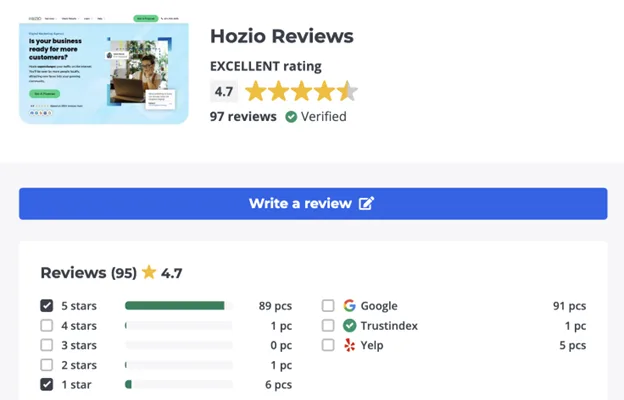
You can’t manufacture good reviews; you have to earn them. So, step one is to deliver excellent SEO results that impact your client’s bottom line. When you do that, many clients will leave a review without even being asked.
But don’t leave it to chance. Once you’ve delivered a solid win, be proactive:
- Ask for testimonials right after you’ve hit a key milestone
- Turn results into case studies (with permission)
- Encourage Google reviews, especially for local SEO
- Take screenshots of positive feedback from emails or Slack to repurpose in marketing
- Highlight client wins on social media, and tag them when possible
- Use a social media aggregator like Juicer Social to automatically collect and display customer reviews on your website to reach more visitors
6. Invest in Scalable SEO Tools
As your agency grows, so do your deliverables, reporting needs, and client expectations. The scrappy tools you used for your first five clients may not cut it once you’re managing 50 clients. A scalable SEO tech stack lets you handle more work, automate repetitive tasks, and deliver consistent value without burning out your team.
But what does it look like in practice? There’s no one-size-fits-all answer, but it should check most of these boxes:
- Flexible pricing tiers so you don’t overpay early on but aren’t forced to switch tools later
- Multi-client dashboards and white-label options for easier reporting
- Automation features to handle repetitive tasks like audits, rank tracking, or link monitoring
- Team collaboration tools to streamline internal workflows
- Reliable support so your team can move fast when something breaks
Here’s an example tech stack from Hozio, which helped them grow the agency from zero to seven figures.
a. Keyword.com: For Accurate Rank Tracking
Keyword.com’s rank tracker gives clients a clear view of their SEO performance without making them sift through messy reports. And in the agency world, transparency builds trust. Hozio relies on Keyword.com for accurate keyword performance monitoring (with 96.8% accuracy), but our tool does much more, including:
- AI overview tracking
- Local SERP monitoring
- Share of Voice insights
- White-label SEO reports
See the complete list of Keyword.com’s rank tracker features.
b. Ahrefs: For Backlink Analysis
From competitor research to backlink monitoring, Ahrefs helps agencies uncover valuable insights to refine their SEO strategies. Hozio uses it to track new backlinks as part of their offsite SEO efforts and monitor clients’ link profiles.
c. Semrush: For SEO Audits
Semrush helps agencies find technical SEO issues and optimize their overall strategies. Hozio uses it to run in-depth SEO audits, identify technical issues, and track on-site improvements over time.
d. Confidential Homebrew Tools: For Processes and Workflow
There’s not much to say here, except yes, we’re curious too! Even with the mystery, the principle stays the same: invest in SEO tools that help you scale.
7. Lower the Stakes for Clients to Close Hot Deals
Remove friction points in your sales process — anything that drags out the timeline or makes clients hesitate — so it’s easier for clients to say yes.
For some agencies, that’s rigid pricing. For others, it’s long-term contracts, a confusing onboarding process, or a lack of flexibility in your packages. These pain points might seem small, but they can be the difference between a closed deal and a “we’ll get back to you.”
At Hozio, removing long-term contracts made a huge difference. Clients sign on month-to-month — which lowers their risk, builds trust from day one, and puts healthy pressure on the agency to consistently deliver results and prioritize client satisfaction.
Consider these sales strategies to make it easier for clients to say yes:
- Performance-based pricing: consider results-driven pricing models (e.g., pay-for-performance SEO) to build trust.
- Flexible exit options: a refund clause or short initial term can ease decision-making.
- Smaller entry points: propose smaller projects instead of a full-scale retainer to hesitant clients.
- Transparent offers: simplify pricing so clients know exactly what they’re paying for.
Once you’ve built trust and proven your value, it’s much easier to secure long-term commitments.
8. Build a Repeatable Client Acquisition System
One of the biggest bottlenecks agencies face is inconsistent lead generation. You might get a referral for one month, then nothing for six weeks. That kind of unpredictability makes it impossible to plan for growth.
To scale, you need a repeatable client acquisition system — something that works without you having to hustle in DMs or wait on word of mouth.
You can acquire clients through:
- SEO on your own site: you’d be surprised how many SEO agencies neglect their own content. Start ranking for high-intent keywords like “local SEO services for law firms” or “ecommerce SEO audit.”
- Lead magnets: offer free SEO audits, checklists, or templates in exchange for email addresses. Then, nurture those leads with helpful content.
- Email automation: send value-packed emails that position your agency as a trusted expert.
- Content repurposing: turn blog posts into videos, social posts, and email snippets. Make your presence felt across multiple channels.
- Paid ads: once you know your ideal client and offer, experiment with paid search or social ads to scale faster.
Learn more: How to acquire and retain clients as a new SEO agency
9. Know Your Agency’s Profit Margins
It’s easy to grow top-line revenue while bottom-line profit stays flat or, worse, disappears. If you’re not watching your margins, you might be scaling a broken business.
Here’s how to keep a healthy cash flow and bottom line:
- Track your time: make sure your team isn’t over-servicing retainers. Tools like Harvest or Toggl help you compare time spent vs. time billed.
- Review pricing regularly: underpriced services will kill your margins as your team grows. Build a buffer room to account for strategy, communication, and revisions.
- Outsource smart: for tasks like link building or content writing, outsourcing can be more cost-effective than hiring in-house if you maintain quality.
- Keep financials clean: use tools like Bench, QuickBooks, or Xero to get visibility into your income, expenses, and cash flow. Knowing your numbers helps you make better growth decisions.
You don’t have to be an accountant, but you do need to know if your growth is profitable.
10. Focus on Client Retention, Not Just Acquisition
Acquiring a new client is typically more expensive than keeping an existing one. So, if you’re always chasing new deals while old clients quietly churn, you’re running uphill.
Great agencies scale by focusing on client retention as much as on acquisition. To do that:
- Start strong: the first 30 days are make-or-break. Nail onboarding, set expectations, and show quick wins early.
- Report results in plain and simple language: Don’t overwhelm clients with SEO jargon. Highlight what matters: rankings, traffic, leads, revenue.
- Communicate proactively: check in regularly, share progress updates, and flag issues early. Our SEO project planner template can help you create visibility for clients and ensure everyone stays on the same page.
- Offer value-adds: recommend small upgrades, additional services, or fresh keyword opportunities. Be a strategic partner, not just a vendor.
Liam Quirk, founder of Quirky Digital, shares more tips on how to turn one-time projects into recurring business for your agency.
11. Productize Your Services
Productized services — clearly scoped, packaged offerings with set pricing — reduce lengthy sales cycles, helping you scale your agency more efficiently. Think of it like putting your offers on a menu. Clients can quickly understand what they’re getting, and your team knows exactly how to deliver it. No unnecessary back-and-forth that can drag out for months.
You don’t need to productize your entire agency overnight. Start with the service you do most often or the one with the highest margin. Build out a basic scope, set a flat price, and test how it performs in your sales process.
Let’s say you’re constantly doing one-off SEO audits. You could turn that into a defined offer:
“Local SEO Audit: We’ll review your GBP, citations, on-page SEO, and local rankings. You’ll get a prioritized action plan with fixes — delivered in 10 business days.”
Now, you have a deliverable, a timeline, and a value-driven outcome. You can put that on your site, in emails, sales calls, etc.
One more practical note: if you productize services, especially recurring subscriptions or SaaS-style offerings, factor tax compliance into your pricing and invoicing. Subscriptions can be taxable depending on where the buyer is located. Consider using a global tax-compliance tool like Sphere to automate tax calculations, filings, and invoices so you don’t underprice offers or face unexpected liabilities.
Other ideas for productized SEO services include:
- On-page SEO package: includes keyword research, title/meta optimizations, and internal linking fixes
- Link-building kickstart: x number of high-quality backlinks with reporting
- Ecommerce SEO foundation: category page SEO + product optimization + technical cleanup
- Monthly growth plan: ongoing keyword tracking, reporting, and iterative content updates
Learn more: The best keyword performance monitoring tools for agencies
12. Train Your Team for Scale
As you take on bigger clients and more complex projects, your team needs the skills and confidence to meet those demands. That means ongoing training, clear paths for growth, and a culture that rewards innovation.
Studies show that employees who gain new skills are more confident, which leads to stronger performance, more creative ideas, and better client outcomes. In short, when your team levels up, your agency scales faster.
Hozio is a great example. They’ve found a way to balance perks with professional development. Sure, they have cool perks like a gym and a golf simulator, but they also prioritize team training and reward employees for innovative thinking. That combination has helped them build a strong, growth-minded team culture.
And this isn’t just good for morale. Employee satisfaction directly impacts customer experience, which is critical in service-based industries like SEO and digital marketing.
Here’s how to build a team that can scale with your agency:
- Invest in skill development: offer SEO training, courses, or certifications that match your agency’s services.
- Support career growth: help team members move into more strategic roles with mentorship and internal promotions.
- Foster a feedback culture: regular check-ins keep performance aligned with business goals.
- Reward innovation: recognize employees who bring in new ideas, improve workflows, or drive client growth.
- Encourage peer learning: create focused groups that give employees the chance to learn from each other, share ideas, and collaborate on ideas.
Growing a Digital Marketing Agency Is a Continuous Process
There’s no finish line when it comes to agency growth. You’ll hit milestones, sure. But there’s always a new challenge around the corner. That’s why the most successful digital marketing agencies don’t chase shiny tactics. They focus on doing the fundamentals better, again and again.
So, instead of chasing the next big thing, double down on the strategies that move the needle. Keep testing, keep improving, and stay focused on what matters most: delivering results for your clients and building systems that support your next stage of growth.
The right tools can make that journey easier. Try Keyword.com for free for 14 days to track rankings, prove your results, and build trust with clients.
Need more strategies for growth? Check out the Agency Growth Series for real-world advice to help you scale your SEO business.
FAQs About Scaling Your Digital Marketing Agency
Find answers to common questions about scaling your digital marketing agency from zero to six figures.
1. How Long Does it Take to Scale a Digital Marketing Agency?
There’s no set timeline. Growth depends on your niche, business model, and ability to execute consistently. Some agencies scale to six or seven figures within a few years, while others take longer. The key is focusing on repeatable systems, client retention, and sustainable growth strategies instead of chasing quick wins.
2. What’s the Biggest Mistake Agencies Make When Scaling?
Scaling without the right tools and systems is a recipe for chaos. Many agencies take on too many clients too quickly, only to struggle with inconsistent results, operational bottlenecks, and client churn. The key is building a strong foundation first, like investing in efficient workflows, automation, and tools that support growth.
For example, having a reliable way to track SEO performance ensures transparency with clients and makes scaling smoother. That’s why agencies rely on tools like Keyword.com because proving results shouldn’t slow you down.
3. How Do Digital Agencies Get Clients?
Digital marketing agencies get clients through a mix of inbound and outbound strategies. These include referrals, word-of-mouth marketing, content marketing, and SEO efforts.
4. How Do I Promote My Digital Marketing Agency?
Promoting your digital marketing agency takes more than just offering excellent services. You need to put yourself in front of the right people consistently. Here are some proven ways to build visibility and attract clients:
- Optimize your website for SEO to rank for relevant keywords
- Share client wins and testimonials to build trust
- Stay active on LinkedIn and social media, where your audience hangs out
- Run targeted paid ads (Google, Meta, LinkedIn) to generate leads
- Create valuable content like blog posts, case studies, and guides
- Pitch yourself to podcasts or blogs to build authority
- Offer free audits or resources to start conversations with prospects
- Network through events, webinars, or online communities for referrals
Check out Liam Quirk’s insights for more tips on promoting a digital marketing agency without paid advertising.