Top 7 Rank Tracker API Use Cases for SEO Agencies

Rank tracker software helps SEO agencies monitor keyword rankings, track competitors, and analyze search engine performance. It provides valuable insights and reporting that can improve SEO strategies and boost search visibility. However, rank tracker software can have limitations, especially when it comes to managing large-scale data or adapting to specific business needs.
This is where an SEO API for rank tracking offers greater flexibility. Unlike traditional software, an API allows you to directly integrate ranking data into your systems and workflows without relying on a standalone tool. You can pull in real-time ranking data for multiple locations, devices, and search engines as needed and customize the data retrieval to match your specific needs.
With an SEO API, you get more control over how and when you access data, allowing for scalable, efficient, and accurate rank tracking that can evolve with your business. In this article, you’ll learn seven top ways to use keyword tracking API in your SEO agency. We’ll also throw in some frequently asked questions for extra measure.
At a Glance: Seven Ways to Use a Rank Tracker API for SEO
- Track bulk keywords at a cost-effective rate
- Create custom reports and SEO dashboards
- Integrate keyword ranking data with BI tools
- Streamline SEO workflow and data management
- Analyze your competitors
- Scrape SERP data
- Analyze backlinks to boost link-building efforts
1. Track Bulk Keywords at a Discount
A rank tracker API lets you track a large number of keywords at a more affordable rate. Regular keyword rank trackers have usage limits that might make them unsuitable for growing SEO agencies managing multiple clients.
Take our monitoring tool, Keyword.com, for example. While our pricing starts at just $3 per month, that plan only allows you to track 50 keywords with weekly updates. If you’re managing multiple clients and running concurrent SEO campaigns, this budget-friendly option simply won’t cut it.
With our keyword tracking API, you’ll be able to track up to 5,000 keywords for only $46 per month. You’ll also have access to our premium keyword monitoring features like built-in integrations and historical SERP data.
2. Create custom reports and SEO dashboards
A rank tracker API lets you pull and display ranking data in custom reporting tools that your typical SEO tool might not sync with. That way, you’re not stuck with the built-in SEO reporting integrations that come with your standard rank tracker software.
For example, Keyword.com integrates with reporting tools like DashThis and Oviond. But maybe your client wants to view their keyword ranking reports in Databox or some other tool. With our rank tracker API, you’ll be able to sync with and display SEO dashboards on your clients’ preferred SEO dashboard tool.
Unlike pre-made reports from SEO tools, an API lets you decide exactly what metrics are important to your business or your clients. You can choose to track specific keywords, analyze performance across different search engines, or look at rankings from a particular location or device type.
3. Integrate Keyword Ranking Data With BI tools
Google SERP tracker APIs can integrate with business intelligence (BI) tools like Tableau and Power BI to enhance your agency’s data analysis and visualization capabilities. This offers benefits beyond SEO reporting by allowing you to interpret SEO data within a broader business context.
As an example, Keyword.com rank-tracking API connects to Google Looker Studio for a comprehensive, dynamic dashboard.
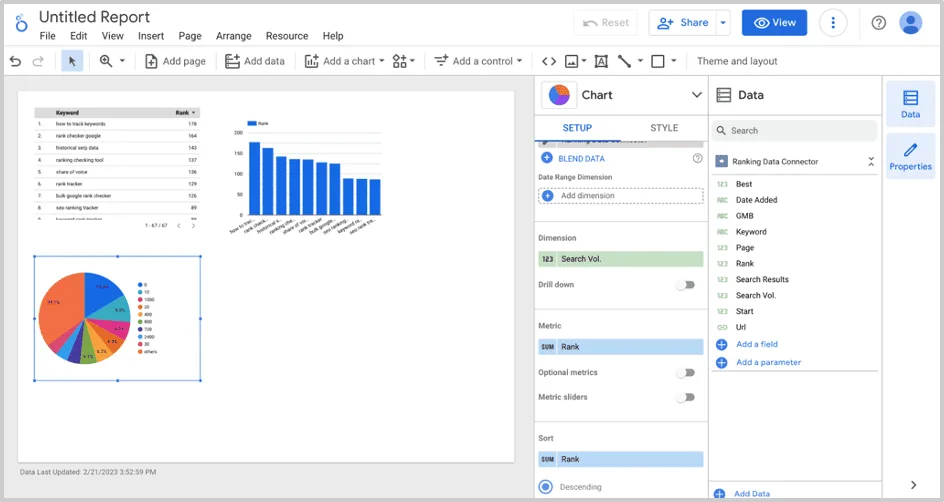
Source: Looker Studio Report
This integration allows you to:
- Monitor SEO performance and effectiveness alongside other critical business metrics, providing a holistic view of your client’s online visibility.
- Edit your data and build interactive reports that update in real-time. This means you can tailor your dashboards to highlight the most relevant information for each client.
- Create easy-to-understand visual representations of SEO data, so clients can easily understand the results.
- Incorporate data from various sources, including third-party tools and spreadsheets, to create a comprehensive analytics hub.
This is especially beneficial for SEO agencies offering . Integrating a rank tracker API and BI tool will enable you to build a new application to meet clients’ needs.
4. Streamline SEO Workflow and Data Management
Data management is another important rank tracker API use case. It enables you to manage large volumes of keywords and data across multiple clients.
The rank tracker API makes transferring data between tools and platforms easy, removing the need for manual entry and export. Ranking data can flow directly into reports and client dashboards without manual input, saving time and reducing the risk of human error.
Streamlining the ranking process gives your team access to the same information, fostering better collaboration and increasing internal efficiency.
In addition, the tool’s real-time data sharing allows you to provide accurate information about organic search visibility and the latest ranking changes to a client, enabling you to create more agile SEO strategies.
5. Analyze Competitors’ SERP Performance
Keyword tracking software allows you to monitor the performance of specific keywords relevant to your website and your competitors. This can help you identify untapped keyword ideas and opportunities to improve search visibility and organic traffic.
However, as you scale your business, you might need to show clients you can do more by sharing robust, sometimes granular, competitor analysis data.
You can combine a rank tracker API with competitor analysis tools like SimilarWeb and SpyFu to better understand your clients’ competitive landscape and refine their SEO strategies.
But even without integrating with these tools, our rank tracker API gives you access to detailed competitor ranking data, which you can analyze to drive your client’s SEO strategies.
When you use Keyword.com’s rank tracker API to run a competitor analysis, you get the following;
- The competitor’s current keyword performance over time.
- Historical SERP data insights
- Their current SERP ranking in real-time
- Tracked keyword search volume
- SEO visibility score, and
- SEO Share of Voice
By analyzing these metrics, you can gauge your client’s competitive position in the market.
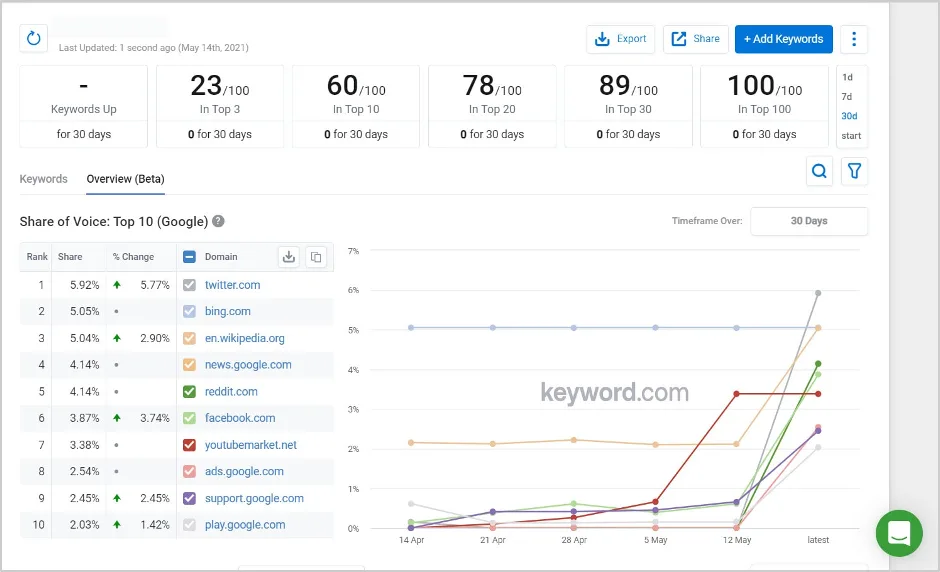
Source: SEO Share of Voice
For instance, a high SEO share of voice indicates that your client’s website ranks for keywords relevant to its niche and is seeing increased organic traffic. Likewise, if they don’t receive much web traffic or have low organic visibility, their SEO share of voice is low, and you’ll need to optimize specific metrics accordingly.
6. Scrape SERP Data
To spot ranking trends on the SERPs, you need to collect data over time consistently. This is why web scraping is essential for SEO analysis, especially in niche industries where generic SEO tools won’t provide adequate information.
A rank tracker API lets you scrape various data types from the SERPs. Depending on which one, you may be able to extract the following:
- Organic search results: this includes the URLs, titles, and meta descriptions of the pages ranking for a given keyword.
- SERP features: information about special features like featured snippets, knowledge panels, local packs, image carousels, and video results.
- Ranking positions: the specific position of each result on the SERP, including your target website and competitors.
- People Also Ask (PAA) boxes: questions and answers that appear in the PAA section.
- Related searches: the list of related search queries that often appear at the bottom of the SERP.
- Rich snippets: structured data that appears in search results, such as star ratings, prices, or availability information.
However, with our keyword tracker API, you can gather information on SERP competitors across thousands of keywords. You’ll also get data on keyword positions over time to identify ranking shifts, as well as the SERP features these keywords trigger, their search volume, search intent, and cost per click (CPC).
By integrating SERP scraping capabilities into your workflow, you can gain comprehensive insights into search visibility, content gaps, competitor performance, and overall SERP trends for specific keywords or phrases.
This will help you understand where these keywords rank and the context of the SERPs they’re competing in.
7. Analyze Backlinks for Link-Building Efforts
While backlink analysis is often associated with dedicated link-building software, integrating a rank tracker API can provide valuable insights to support your link-building efforts. Understanding the correlation between backlinks and higher rankings allows you to make more informed decisions and validate your SEO strategies.
For instance, you can use keyword tracking data to establish a baseline and measure results from a link-building campaign. Before you begin, record your target URL’s ranking for its primary keyword and related long-tail variations. This initial data will help you evaluate the effectiveness of your campaign.
Watch your rankings for primary and secondary keywords as you acquire new backlinks. As search engines discover and factor in the new backlinks, you should expect gradual improvements. You can validate the effectiveness of your backlink strategy with this ongoing tracking and plan future campaigns based on the data.
For deeper insights, combine data from the keyword monitoring tool with other key metrics, such as:
- Organic traffic (sessions)
- Conversions
- Conversion rates
Analyzing these metrics alongside ranking data allows you to identify high-potential pages for link-building. For example, if a page ranking third for a target keyword is getting tons of traffic and converting well — focus on building links to it. This will boost this page’s ranking, increasing organic traffic and conversions.
Essentially, using a rank tracker API for backlink analysis helps you:
- Prioritize pages for link building based on their potential impact.
- Provide clients with proof that your link-building efforts are effective.
- Adapt strategy based on new backlinks and observed ranking changes.
Learn more: How backlinks affect keyword rankings
Scale Your SEO Efforts With Keyword.com’s Rank Tracker API
From all we’ve said so far, you’ll see that a rank tracker API is a worthwhile addition to your SEO toolkit. It gives you ultimate control and flexibility, empowering you to deliver stellar results for your clients.
Want to try things out for your agency and clients? Get started with Keyword.com’s rank tracker API. For only $46 per month, you can track up to 5,000 keywords. You also get a discount if you track a higher number of keywords.
API Use Cases FAQs
Find answers to common questions about rank tracker API use cases.
1. What is a Rank Tracker API?
A rank tracker API is a keyword monitoring tool that tracks search engine rankings for specific keywords. You can integrate this tool into your own apps and analytics platforms to create a more robust SEO dashboard and reporting hub.
2. How Do I Track my Google SERP Rankings Via API in SEO?
You can track your Google SERP ranking with Keyword.com’s rank tracker API. Enter or upload the keywords you want to track on the platform’s dashboard and fill in other parameters like your website’s URL and location to fetch the ranking data. Track your ranking data over time to get more accurate readings and see how it changes.
3. What is the Best Bulk Rank Checker on the Market?
While several options are available, Keyword.com stands out as a highly effective bulk rank checker. It allows you to check the rankings of multiple keywords across various locations simultaneously.
When evaluating bulk rank checkers, consider factors like accuracy, ease of use, pricing, and additional features. Keyword.com excels in these areas, offering reliable data, an intuitive interface, and affordable pricing. It also has a range of advanced features you can use to boost your rankings.
4. Are There Any Rank Tracker APIs That Offer Real-Time Tracking?
Yes, the Keyword.com Rank Tracker API offers real-time tracking capabilities. While many rank-tracking APIs update keyword rankings periodically, Keyword.com provides more frequent updates, allowing you to monitor changes in rankings throughout the day. This is particularly useful for SEO agencies or digital marketers who need to closely monitor their search engine performance and make timely decisions based on the most current data.